2025
Way.com
Insurance

An end-to-end AI claims platform designed to help insurers move from image submission to damage assessment and final reporting in a single workflow.
Lead Product Designer
Owned the product experience from workflow definition and UX strategy to UI, AI interactions, prototyping and developer handoff.
1 Month
PM + Engineering + AI + Me
Web SaaS
UX Strategy · Product Design · AI UX · UI Design
Background
Insurance claims weren't built for AI.
A vehicle claim can involve customer information, policy validation, vehicle images, damage assessment, parts, labor rates and documentation — often spread across multiple steps and tools.
The opportunity wasn't simply to automate the process.
It was to help adjusters make better decisions with AI, while keeping them in control.


[ Core problem]
The challenge wasn't collecting data.
It was turning evidence into a decision.
Claims are built from fragmented evidence — vehicle images, policy information, damage details, parts, rates, and documentation.
Adjusters had to bring all of this together, assess the damage, verify information, and make a decision, often across multiple steps and tools.
The opportunity was to use AI to reduce that cognitive load without turning the process into a black box.
The AI could recommend. The adjuster still needed to understand, verify, and decide.


From Evidence to a Decision
A connected claims workflow where every step builds on the one before it.
1
Capture
Start with better evidence - Guide users through the right vehicle views and capture the information needed for an accurate assessment.
2
Understand
Let AI make sense of the evidence - AI analyzes vehicle images to identify visible damage, recognize relevant vehicle details, and surface findings for the adjuster.
3
Assess
Turn findings into a structured assessment - Bring detected damage together with affected parts, repair information, and claim context so the adjuster can understand the potential impact.
4
Review
Keep the decision in human hands - AI recommendations are presented for review, giving adjusters the context to validate, edit, or override findings before finalizing the claim.
5
Report
Turn an approved assessment into a final outcome - Once the assessment is complete, structured claim information flows directly into the final report — without manually rebuilding the work.
From Evidence to AI-Assisted Assessment
The first part should establish how the product transforms raw vehicle evidence into useful intelligence.
From capturing evidence to understanding damage
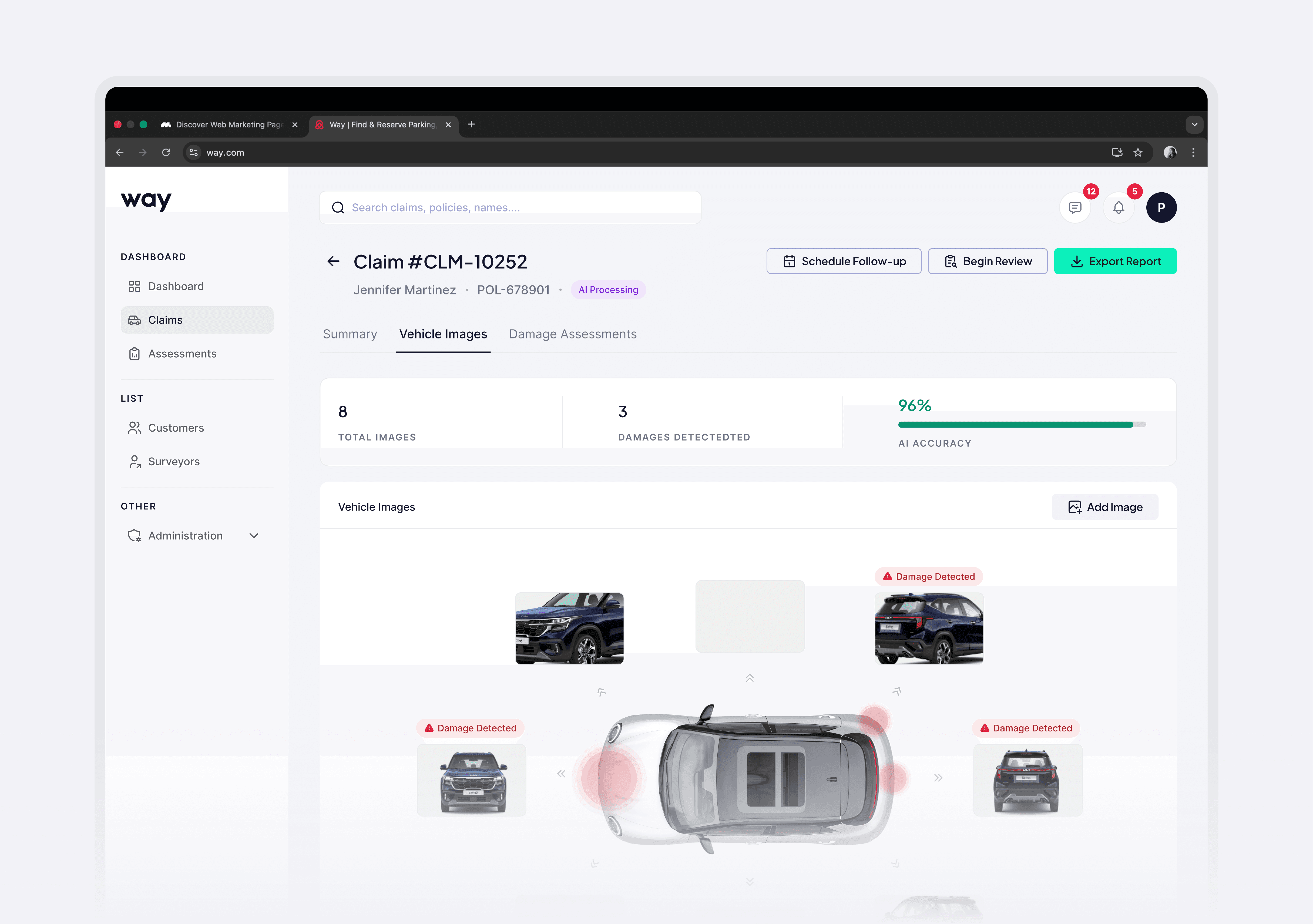
A claims decision is only as good as the evidence behind it. We designed the experience to guide adjusters through evidence collection while using AI to interpret vehicle images, identify visible damage, and surface relevant information.
Rather than treating image upload as a simple input step, the experience was designed as the beginning of an intelligent assessment workflow — helping users capture better evidence and quickly understand what the AI has identified.
Key Actions Taken
Guided Evidence Capture: Structured the image-capture experience around the specific views and evidence needed for assessment.
Validated Inputs: Added image validation and contextual guidance to reduce incomplete or unusable evidence.
Automated Damage Detection: Used AI to identify visible damage from vehicle images and surface relevant findings.
Connected Evidence to Findings: Linked AI-generated observations back to the vehicle image and relevant damage areas.
Reduced Manual Interpretation: Turned raw visual evidence into structured information that adjusters could review.
Key Outcomes
Guided and consistent evidence collection
Faster understanding of vehicle damage
AI-assisted image assessment
Evidence connected directly to AI findings
Less manual interpretation for adjusters

Designing the Adjuster's AI Workspace
This should combine the AI experience + unified claim workspace sections.
The story here is not "look at our dashboard."
It's:
How do you bring AI, evidence and claim information together without overwhelming the person making the decision?
Turning AI output into something an adjuster can actually work with
AI can identify patterns and generate recommendations, but an adjuster still needs to understand the claim as a whole.
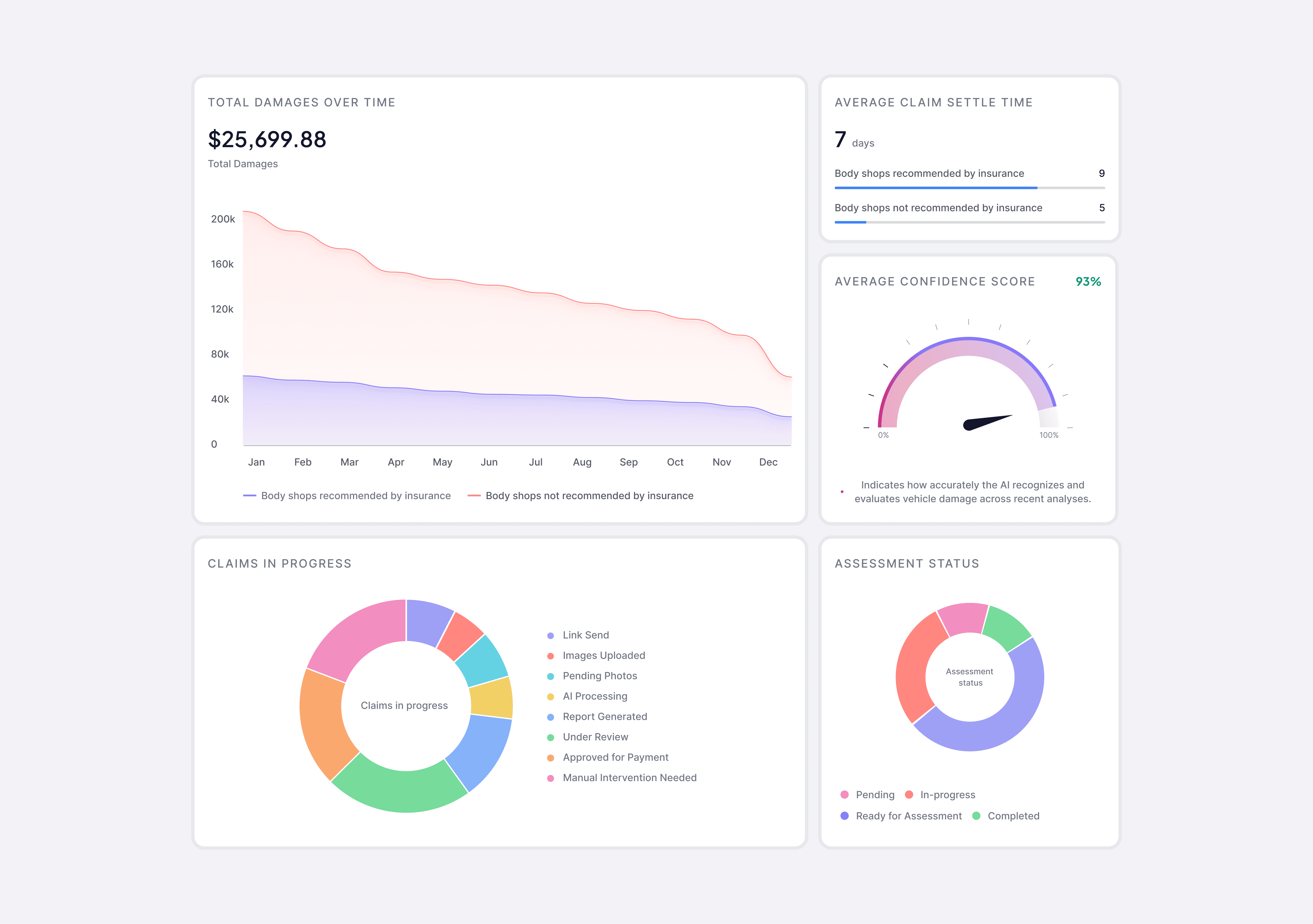
The challenge was therefore to create a workspace where vehicle evidence, damage assessment, policy information, parts, rates and AI recommendations could be reviewed together — without forcing the user to constantly move between different screens.
The interface was designed around context rather than information density: show what matters, explain why it matters, and keep the next action clear.
Key Actions Taken
Created a Unified Claim Workspace: Brought claim, vehicle, evidence and assessment information into one central experience.
Prioritized Information: Organized dense insurance data around the decisions an adjuster actually needs to make.
Made AI Visible but Secondary: AI recommendations were integrated into the workflow without overpowering the human decision-maker.
Connected Related Information: Linked damage findings with relevant parts, estimates, images and supporting evidence.
Designed for Fast Review: Used clear hierarchy, structured cards, tables and status indicators to make complex information easier to scan.
Created Contextual AI Interactions: Allowed users to inspect AI findings rather than simply accepting an automated result.
Key Outcomes
One workspace for the complete claim
Faster access to relevant evidence
Clearer AI recommendations
Reduced context switching
Dense information made easier to scan
A scalable foundation for AI-assisted claims workflows

From AI Recommendation to Human Decision
This should combine Human + AI + Report Generation.
And honestly, I think this should be the most important of the three because it communicates your product-design thinking, not just your ability to design dashboards.
AI can recommend. The adjuster still decides.
The goal was never to remove the adjuster from the claims process.
It was to reduce the repetitive work around assessment so adjusters could spend more time reviewing the information that actually matters.
The final experience therefore treats AI as a decision-support layer, not an invisible automation engine. Recommendations can be reviewed, evidence can be inspected, findings can be adjusted, and the final assessment remains under human control.
Once the assessment is complete, the same structured information can move directly into the final claim report — eliminating the need to reconstruct the work manually.
Key Actions Taken
Made AI Explainable: Presented AI findings alongside the evidence that supports them.
Kept Humans in Control: Designed clear review, edit, override and approval interactions.
Separated Recommendation from Decision: Visually distinguished what the AI identified from what the adjuster confirmed.
Supported Confidence Building: Gave adjusters enough context to validate AI-generated findings before accepting them.
Connected Review to Reporting: Carried approved assessment information directly into the final report.
Reduced Repetitive Documentation: Removed the need to manually recreate information already captured during assessment.
Key Outcomes
Human-controlled AI workflow
Transparent AI recommendations
Faster review and validation
Clear distinction between AI and human decisions
Seamless transition from assessment to report
Less repetitive documentation

[Outcome]
Vision AI turned a fragmented claims assessment process into a connected workflow — from capturing vehicle evidence to AI-assisted assessment, human review and final reporting.
Rather than replacing the adjuster's judgment, the product created a layer of intelligence around it, helping transform unstructured evidence into information that could be reviewed and acted upon.
[Impact]
End-to-End Claims Workflow - Connected evidence capture, AI damage assessment, claim review and report generation into one continuous experience.
Human-Controlled AI - Designed AI recommendations as reviewable inputs rather than automated decisions, giving adjusters the ability to inspect, edit and override findings.
Evidence-Driven Assessment - Connected AI findings back to vehicle images, damage areas and claim information, making recommendations easier to understand and validate.
[Key Learnings]
AI UX Is About Building Confidence
An accurate AI recommendation isn't enough in a claims workflow. Adjusters need to understand what the system found, where it found it, and whether they agree with it. Designing that relationship became as important as designing the AI output itself.
Automation Needs an Exit Route
Real-world claims aren't predictable. Damage can be unclear, evidence can be incomplete, and AI can be wrong. Designing clear review, edit and override paths made the system more useful than trying to automate every decision.
Complex Products Need Progressive Disclosure
Insurance platforms contain a huge amount of information, but showing everything at once doesn't make the product more powerful. We learned to reveal deeper information when the decision required it, while keeping the primary workflow easy to scan.
From Evidence to a Decision